Before you tour a single building, find out which local
government the property answers to. That one detail affects
your zoning rules and tax rates. This guide covers what
business owners should know about commercial real estate
in Fairfax, VA, from leasing versus buying to the permit
that can delay your move-in.
Fairfax County or the City of Fairfax: Confirm the Jurisdiction First
A Fairfax, VA mailing address can belong to two different
governments. The City of Fairfax is an independent city
with its own zoning ordinance and tax rates. It sits
within the geographic boundaries of Fairfax County
but is not part of the county government.
The difference shows up in your costs. The business
license tax (BPOL), generally calculated on gross
receipts, is one example. A 2026 City of Alexandria
regional comparison lists financial-services rates
of $0.19 per $100 of gross receipts in Fairfax County
and $0.40 in the City of Fairfax. Rates vary by
business category, and exemptions or thresholds may apply.
Confirm the jurisdiction using official county or city
property and zoning resources before comparing spaces.
The rest of this guide focuses on Fairfax County.
The Main Types of Commercial Property in Fairfax County
Office Space in Fairfax, VA
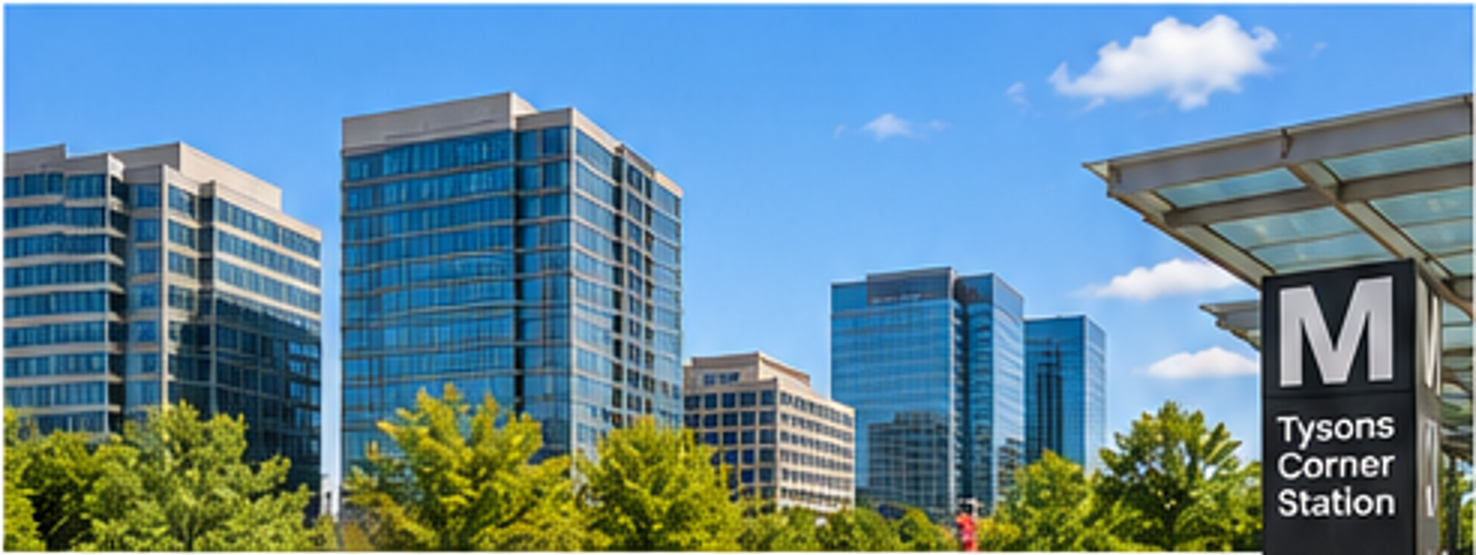
Much of the office space in Fairfax, VA clusters in
areas such as Tysons and Reston. Both have Silver Line
Metro stations, giving your staff and clients
a convenient transit option.
Whether your business needs a small professional office,
medical office, or larger corporate headquarters,
location and accessibility play an important role
in choosing the right space.
Retail and Flex Space
Retail space ranges from shopping centers to street-level
space in mixed-use buildings. Flex space suits businesses
that need storage, distribution, or light assembly areas.
The zoning district determines which uses a property
allows, so confirm your intended use before negotiating
a lease or purchase agreement.
Commercial Property for Lease in Fairfax, VA
Before comparing commercial property for lease in
Fairfax, VA, understand how the lease structure
affects your real monthly and annual costs.
Lease Structures You Will See
In a full-service gross lease, the landlord generally
includes operating expenses such as real estate taxes,
insurance, and certain building services in the rent,
subject to the terms of the agreement.
In a triple net (NNN) lease, the tenant pays base rent
plus an allocated share of property taxes, insurance,
and maintenance expenses.
Ask for the property’s operating expense history
and review how increases, reconciliations, and
additional charges are calculated before signing.
The Non-RUP: Your Permit to Open
Fairfax County generally requires a Non-Residential
Use Permit (Non-RUP) for commercial occupancy,
including many situations where a new tenant moves
into an existing space.
The permit process helps confirm that the proposed
business use meets applicable zoning and code requirements.
Check the county’s requirements for your particular
property and use before committing to a move-in date.
Consider negotiating a lease provision that provides
adequate time to obtain required approvals before
rent begins or other significant obligations take effect.
Fairfax County readopted its modernized zoning
ordinance on May 9, 2023, so older guides
may describe rules that have since changed.
When Leasing Makes Sense
Leasing can preserve working capital and provide
flexibility as your business grows or changes.
It may be especially attractive for businesses
that anticipate changing their space requirements
over the next several years.
Commercial Property for Sale in Fairfax, VA
Buying commercial property gives your business
greater control over its space and the opportunity
to build equity over time. Ownership also means
taking responsibility for the full cost of the property.
Ownership Costs Beyond the Mortgage
For tax year 2026, Fairfax County’s base real estate
tax rate is $1.12 per $100 of assessed value.
Commercial and industrial properties are also subject
to an additional commercial transportation tax
of $0.125 per $100 of assessed value.
Certain locations, including portions of the
Dulles Rail and Route 28 districts, may have
additional special district tax rates.
Property owners should also budget for maintenance,
repairs, insurance, utilities, and capital improvements.
Confirm current tax rates and district assessments
for the specific property.
Financing an Owner-Occupied Building
Many business owners consider financing through
the SBA 504 loan program.
In a typical eligible SBA 504 transaction, a bank
or other lender provides approximately 50% of
the project cost, a Certified Development Company
provides up to 40% through an SBA-backed loan,
and the buyer contributes as little as 10%.
Actual terms and borrower contributions vary.
For an existing building, the operating business
generally must occupy at least 51% of the property
to meet the SBA’s owner-occupancy requirement.
Learn more about how Elkins-Lane supports buyers
through our
Financing the Transaction
service.
A Note for Investors
Investors selling one investment property and
purchasing another may be able to defer certain
capital gains taxes through an IRS Section 1031
like-kind exchange.
Strict identification deadlines, closing timelines,
and eligibility requirements apply. Consult a
qualified tax adviser before proceeding.
Learn more from our
IRS Section 1031
resource.
Leasing vs. Buying Commercial Real Estate at a Glance
Every business has different financial priorities
and long-term objectives. This comparison highlights
several important differences between leasing
and purchasing commercial property.
| Consideration | Leasing | Buying |
|---|---|---|
| Upfront Cash | Security deposit and move-in expenses |
Down payment and closing costs; some SBA 504 transactions may qualify for as little as 10% down |
| Flexibility |
Determined by lease term, renewal options, and other provisions |
Selling or leasing the building may be necessary when relocating |
| Taxes and Repairs |
Included in rent or charged separately according to lease terms |
Owner is responsible for property taxes and maintenance |
| Equity | No property equity is created |
Potential equity growth through principal repayment and appreciation |
| Long-Term Control |
Subject to landlord approval and lease restrictions |
Greater control over property improvements and occupancy |
How a Commercial Real Estate Broker in Fairfax VA Helps
The listing broker on a commercial property
typically represents the landlord or seller.
Working with a commercial real estate broker
in Fairfax VA who represents your interests
can help you evaluate available properties
and negotiate more favorable terms.
An experienced commercial real estate adviser
can assist with:
- Comparing leasing and purchasing costs
- Identifying suitable commercial properties
- Evaluating locations and accessibility
- Reviewing zoning and permitted uses
- Coordinating permit and occupancy planning
- Negotiating lease and purchase terms
- Planning for long-term business growth
Elkins-Lane Realty Advisors offers professional
tenant representation
services to help businesses make informed
commercial real estate decisions.
Broker compensation arrangements should
be confirmed before entering into an agreement.
Before You Lease or Buy: A Checklist
-
Confirm whether the property is located
in Fairfax County or the City of Fairfax. - Verify zoning and permitted business uses.
- Review Non-RUP and other occupancy requirements.
-
Compare total lease costs, including
additional operating expenses. -
Budget for real estate taxes,
insurance, and maintenance if buying. - Review special district tax obligations.
- Ask your broker for a lease-versus-purchase analysis.
Frequently Asked Questions
Is the City of Fairfax Part of Fairfax County?
No. The City of Fairfax is an independent
municipality with its own zoning rules,
local government, and tax rates.
A Fairfax mailing address does not
automatically mean a property is
located in Fairfax County.
Do I Need a Permit Before Moving My Business Into a Fairfax County Space?
Commercial tenants generally need to obtain
a Non-Residential Use Permit (Non-RUP)
before occupying a business space in Fairfax County.
Check the requirements for your proposed use,
and allow sufficient time in your move-in schedule.
Is It Better to Lease or Buy Commercial Property?
The best decision depends on your business’s
available capital, anticipated growth,
financing options, and long-term plans.
A detailed financial comparison can help
determine which approach makes the most sense.
Talk to a Fairfax Commercial Real Estate Advisor
Choosing between leasing and buying commercial
property is an important business decision.
The right property should support both
your current operations and future growth.
Elkins-Lane Realty Advisors | Weichert Commercial
helps business owners evaluate commercial
real estate opportunities throughout Fairfax,
Northern Virginia, and surrounding communities.
Whether you need office space, retail property,
flex space, or a building to purchase,
our team can help you compare options
and negotiate terms that fit your needs.
Sources and Additional Resources
-
Fairfax County – Real Estate Tax Rates
-
Fairfax County – Non-Residential Use Permit
-
Fairfax County – Starting a Business Guide
-
Fairfax County – Silver Line Transportation
-
City of Alexandria – Regional BPOL Comparison
-
U.S. Small Business Administration – 504 Loans
-
SBA 504 Loan Eligibility Information
-
Elkins-Lane – Tenant Representation
